Regional Tourism Summit
TR / EN / FR multilingual, ready for AI search.
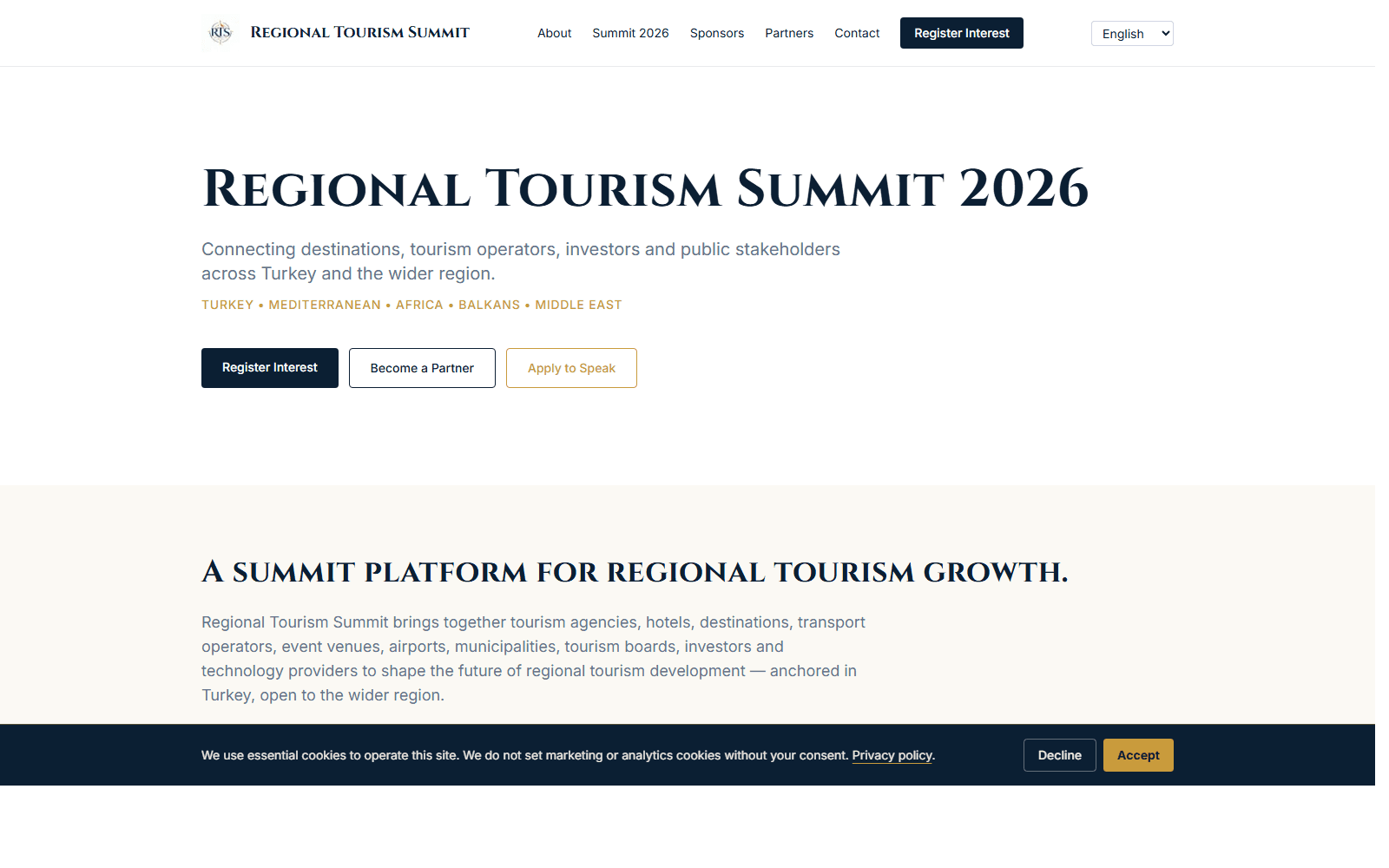
The challenge
Most regional tourism summits run on the 'event = website' model: a single event day, a landing page in the run-up, then 11 months of static. Sponsors disappear from view between editions, no authority or content asset compounds, and search and AI engines get no fresh signal year-round.
What was needed: a year-round B2B platform that combines event + think tank + research authority — multilingual (TR/EN/FR), legible to LLM search engines as context, and editorial-speed for managing sponsors, speakers, regions and themes.
Our approach
Full editorial control on Payload CMS v3: home, about, partners, sponsors, regions, themes, reports, summit2026 — all editable in the CMS, no developer hand-off. A three-language content layer (TR/EN/FR) on Payload's native localization.
AI search visibility built in: /llms.txt + /llms-full.txt for structured LLM metadata. next-intl's [locale] segment was shadowing the root robots.txt / sitemap.xml / llms.txt conventions — we resolved it with an nginx + /api/* proxy pattern that has since become the Dots Group standard for next-intl + AI search sites.
Hybrid admin: Payload /admin/cms for content, the legacy JWT /admin/* for form submissions, analytics, audit logs. Five separate lead-capture forms (Register Interest, Apply to Speak, Partner Application, Sponsors, Contact). Mail goes Postfix relay → Resend for deliverability.
The results
Live since April 2026. CMS content: 8 partners, 3 regions, 2 themes, 1 report, 1 sponsor — all three languages live. Editorial workflow is hand-off-free: editors publish directly from the CMS. Early traffic: 152 page views (internal analytics_events), 2 Register-Interest submissions.
AI-search infrastructure (llms.txt + llms-full.txt + sitemap + schema.org Organization/Event/Article) is still rare across travel sites — RTS is early. We'll track ChatGPT/Perplexity/Gemini citations across the first 3-6 months.
Replicable insight: next-intl and AI-search root files don't have to fight. The nginx + /api/* proxy pattern fixes it permanently and now ships as part of every Dots Group travel + B2B authority deploy.